Wednesday, December 3, 2014

3-D compass in Egyptian fruit bat's brain

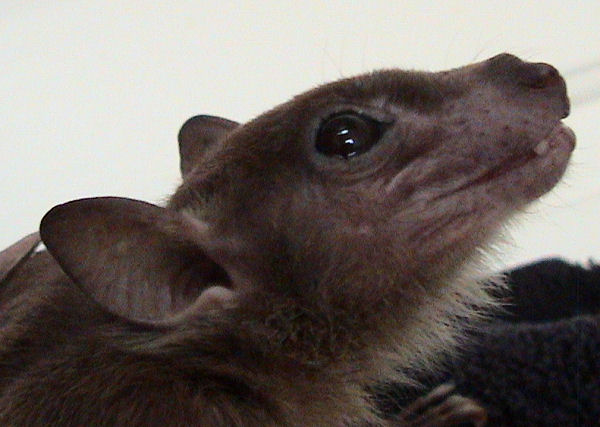
Egyptian fruit bat Rousettus aegyptiacusimage Wikimedia

Ruth Schuster reported 03/12/2014 in Haaretz about a fascinating brain research project going on in Weizmann Institute:

Israeli scientists have finally proved the existence of a three-dimensional compass in mammalian brains, with the help of the humble fruit bat.

Grad student Arseny Finkelstein and team demonstrated that the brain of the Egyptian fruit bat has special neurons that can tell which way its head is pointing. They could be key to the bat navigating in space, says the team in a study published today in Nature.

Vertigo such as that experienced by fighter pilots happens when this system goes haywire, their study suggests.

Navigation relies on spatial memory: past experience of different locations, they explain. That spatial memory is formed in a primitive brain structure in the hippocampus.

In the mammalian hippocampus, there are three types of brain cells key to navigation: “place” and “grid” cells, which like a biological GPS system, enable animals to keep track of their position - and “head-direction” cells. Those are the ones that act like a compass, responding when said beast turns its head.

Much work had been done on place and grid cells but practically none on the head-direction one. To change that, the researchers enlisted fruit bats with micro-electrodes implanted in their brains, to monitor their neuronal activity, and tracking devices that could tell when the bats moved their little heads.

Read the entire Haaretz science article.

LINKS

Wildscreen ARKive has photos, videos and facts about the charming Egyptian fruit bat Rousettus aegyptiacus

Nature article preview  Arseny Finkelstein, Dori Derdikman, Alon Rubin, Jakob N. Foerster, Liora Las & Nachum Ulanovsky Three-dimensional head-direction coding in the bat brain

Monday, October 6, 2014

Nobel Prize for the brain's GPS discovery

image Wikimedia

BBC News website health editor James Gallagher reports October 5, 2014:
UK-based researcher Prof John O'Keefe as well as May-Britt Moser and Edvard Moser share the award. They discovered how the brain knows where we are and is able to navigate from one place to another. Their findings may help explain why Alzheimer's disease patients cannot recognise their surroundings.

Prof O'Keefe, from University College London, discovered the first part of the brain's internal positioning system in 1971. ... His work showed that a set of nerve cells became activated whenever a rat was in one location in a room. A different set of cells were active when the rat was in a different area. Prof O'Keefe argued these "place cells" - located in the hippocampus - formed a map within the brain.

In 2005, husband and wife team, May-Britt and Edvard, discovered a different part of the brain which acts more like a nautical chart. These "grid cells" are akin to lines of longitude and latitude, helping the brain to judge distance and navigate. They work at the Norwegian University of Science and Technology in Trondheim.
...
The Nobel committee said the combination of grid and place cells "constitutes a comprehensive positioning system, an inner GPS, in the brain". They added: "[This system is] affected in several brain disorders, including dementia and Alzheimer's disease.

"A better understanding of neural mechanisms underlying spatial memory is therefore important and the discoveries of place and grid cells have been a major leap forward to advance this endeavour."
Read the entire article from BBC News


Interesting, how advances in modern technology is helping scientists to define questions and use such basic concepts as grid map and GPS in their work!

As we know how devastating Alzheimer's disease is these discoveries about the amazing functionality of our brain have very practical consequences. It is also mapping major routes towards better understanding of the mapping capabilities of insects, fish, birds, land animals and humans our Creator has given to all living things in His great and deep wisdom.


Sunday, December 1, 2013

Memories stored in DNA?

image Emory University Homepage

James Gallagher, Health and science reporter, BBC News 1. 12. 2013 writes about exceptionally interesting research in Emory University on the realm of Mind and Body .
Behaviour can be affected by events in previous generations which have been passed on through a form of genetic memory, animal studies suggest.

Experiments showed that a traumatic event could affect the DNA in sperm and alter the brains and behaviour of subsequent generations.

A Nature Neuroscience study shows mice trained to avoid a smell passed their aversion on to their "grandchildren".

Experts said the results were important for phobia and anxiety research.

The animals were trained to fear a smell similar to cherry blossom.

The team at the Emory University School of Medicine, in the US, then looked at what was happening inside the sperm.

They showed a section of DNA responsible for sensitivity to the cherry blossom scent was made more active in the mice's sperm.

Both the mice's offspring, and their offspring, were "extremely sensitive" to cherry blossom and would avoid the scent, despite never having experiencing it in their lives.

Changes in brain structure were also found.

Read the entire article in BBC News Health

In my classification this information belongs to the category Wow!


Saturday, November 16, 2013

Professor Giulio Tononi

Prof. Giulio Tononi
image wikimedia
English wikipedia tells:
"Giulio Tononi is a neuroscientist and psychiatrist who holds the David P. White Chair in Sleep Medicine, as well as a Distinguished Chair in Consciousness Science, at the University of Wisconsin.

Tononi was born in Trento, Italy, and obtained an M.D. and a Ph.D. in neurobiology at the Sant' Anna School of Advanced Studies in Pisa, Italy. He is an authority on sleep, and in particular the genetics and etiology of sleep.

Sleep
Tononi and collaborators have pioneered several complementary approaches to study sleep. These include
  • genomics 
  • proteomics 
  • fruit fly models 
  • rodent models employing 
    • multiunit / local field potential recordings in behaving animals 
    • in vivo voltammetry
    • microscopy 
  • high-density EEG recordings and 
  • transcranial magnetic stimulation (TMS) in humans, 
  • large-scale computer models of sleep and wakefulness. 

This research has led to a comprehensive hypothesis on the function of sleep (proposed with sleep researcher Chiara Cirelli), the Synaptic Homeostasis Hypothesis. According to the hypothesis, wakefulness leads to a net increase in synaptic strength, and sleep is necessary to reestablish synaptic homeostasis.

The hypothesis has implications for understanding the effects of sleep deprivation and for developing novel diagnostic and therapeutic approaches to sleep disorders and neuropsychiatric disorders.

Consciousness
Tononi is a leader in the field of consciousness studies, and has co-authored a book on the subject with Gerald Edelman. He developed the Integrated Information Theory (IIT): a scientific theory of what consciousness is, how it can be measured, how it is realized in the brain and, why it fades when we fall into dreamless sleep and returns when we dream. The theory is being tested with neuroimaging, TMS, and computer models.

His work has been described as "the only really promising fundamental theory of consciousness" by Christof Koch."
Read the entire article from wikipedia

Thursday, June 20, 2013

First 3D Digital Brain

Great brain machine!
Image GrabCAD Sudhir Gill
In all, 80 billion neurons have been captured in this painstaking process which took 10 years to complete.

The result is a 3D high definition digital brain into which researchers can zoom to study areas of interest in microscopic detail.

One of the researchers involved, Prof Katrin Amunts from the Julich Research Centre in Germany, said that it was "like using Google Earth. You can see details that are not visible before we had this 3D reconstruction".
Pallab Gosh
BBC Science reporter

See also the article in Science BigBrain project

Thursday, May 16, 2013

D-Wave Quantum Computer 2013

Geordie Rose and D-Wave computer
Image copyright BBC News


A $15m computer that uses "quantum physics" effects to boost its speed is to be installed at a Nasa facility.

It will be shared by Google, Nasa, and other scientists, providing access to a machine said to be up to 3,600 times faster than conventional computers.


Reportedly costing up to $15m, housed in a garden shed-sized box that cools the chip to near absolute zero, it should be installed at Nasa and available for research by autumn 2013.

US giant Lockheed Martin earlier this year upgraded its own D-Wave machine to the 512 qubit D-Wave Two.


Unlike standard machines, the D-Wave Two processor appears to make use of an effect called quantum tunnelling.

This allows it to reach solutions to certain types of mathematical problems in fractions of a second.

Effectively, it can try all possible solutions at the same time and then select the best.

D-Wave Systems has been focused on building machines that exploit a technique called quantum annealing - a way of distilling the optimal mathematical solutions from all the possibilities.

Geordie Rose believes others have taken the wrong approach to quantum computing
Annealing is made possible by physics effect known as quantum tunnelling, which can endow each qubit with an awareness of every other one.


Read the entire news article introducing a BBC 4 radio program from here

Sunday, May 12, 2013

Intelligent communication between plants through fungus network

Image BBC Science and Environment
Clever laboratory experiment in the University of Aberdeen has demonstrated the role of fungi in a sophisticated plant alarm system.

"The team concerned themselves with aphids, tiny insects that feed on and damage plants. Many plants have a chemical armoury that they deploy when aphids attack, with chemicals that both repel the aphids and attract parasitic wasps that are aphids' natural predators."
Read the entire article in BBC May 13 2013 

Highly intelligent plants and fungus cooperation and communication!

Wonders of creation that make us respect even more the living world of plants: where's the Brain?


Wednesday, May 1, 2013

Insect eyes


BBC reports May 2, 2013
A digital camera that functions like an insect's compound eye is reported in the journal Nature this week.

It comprises an array of 180 small lenses, which, along with their associated electronics, are stretched across a curved mounting.

The prototype currently has few pixels, so its images are low-resolution.

But the device displays an immense depth of field, and a very wide-angle view that avoids the distortion seen in standard camera lenses.

The development team, led from the University of Illinois at Urbana-Champaign, US, believes its new imaging system could eventually find uses in surveillance and for endoscopic investigations of the human body.

The researchers also suggest such cameras could be fitted to tiny aerial vehicles one day that behaved like robotic insects.

At the moment, the "bug-eye" system's vision is comparable to that enjoyed by some ants and beetles.
Read the entire article from BBC Science and Environment News

The on-line article in Nature

Sunday, February 17, 2013

Brain wiring revealed by high-power scanner

Axial41 top
Brain wiring
Image BBC 
BBC Science writer Pallab Ghosh reports February 17, 2013 about a special treat he received!

Scientists are set to release the first batch of data from a project designed to create the first map of the human brain.

The project could help shed light on why some people are naturally scientific, musical or artistic.

Some of the first images were shown at the American Association for the Advancement of Science meeting in Boston.

I found out how researchers are developing new brain imaging techniques for the project by having my own brain scanned.

Scientists at Massachusetts General Hospital are pushing brain imaging to its limit using a purpose built scanner. It is one of the most powerful scanners in the world.

The scanner's magnets need 22MW of electricity - enough to power a nuclear submarine.

The researchers invited me to have my brain scanned. I was asked if I wanted "the 10-minute job or the 45-minute 'full monty'" which would give one of the most detailed scans of the brain ever carried out. Only 50 such scans have ever been done.

I went for the full monty.
Pallab Ghosh
Read the entire BBC Science article and see the images and video in this link 

Follow up story by P. Ghosh in BBC March 6, 2013

Sunday, February 10, 2013

Henry Markram gets 1 billion to build a brain simulator

Henry Markram explaining neocortical neurons
Image wikimedia
Israeli scientist Henry Markram (b. 1962) has had enough brain power to win over a cosmic European Union one billion euro grant for his research. He is currently the director of both the Blue Brain and the Human Brain Project at École Polytechnique Fédérale de Lausanne.

The enormous grant awarded to Markram is an obvious fact about the convincing power of human mind over other human minds in fierce competition for funding. (The other project that also got the caveted billion euro grant works on graphene.)

The question now is can Markram deliver a working computerized model of brain within the promised time scale so that in 2023 the world will have the Deep Thinker called Blue Brain. It should be simulating the actions of the 86 billion neurons that we seem to control with such ease in our modest 1.4 cubic litre heads?

BBC correspondent Ed Young writes
The very idea has many neuroscientists in an uproar, and the HBP’s substantial budget, awarded at a tumultuous time for research funding, is not helping. The common refrain is that the brain is just too complicated to simulate, and our understanding of it is at too primordial a stage.

Then, there’s Markram’s strategy. Neuroscientists have built computer simulations of neurons since the 1950s, but the vast majority treat these cells as single abstract points. Markram says he wants to build the cells as they are – gloriously detailed branching networks, full of active genes and electrical activity. He wants to simulate them down to their ion channels – the molecular gates that allow neurons to build up a voltage by shuttling charged particles in and out of their membrane borders. He wants to represent the genes that switch on and off inside them. He wants to simulate the 3,000 or so synapses that allow neurons to communicate with their neighbours.
Ed Young
Read the entire article in BBC Future - Science and Environment February 8, 2013

Thursday, August 30, 2012

Brainy bird fishing!


Click here to see with your own eyes how smartly a bird uses piece of bread to catch a fish. 

Talking about the amazing power of bird brains!


Friday, April 27, 2012

Cosmic brain a la Sir Fred Hoyle

Cover of first edition 1957.
wikimedia
Surely you know, Mikko, that the extraordinary ability humans have to think divine thoughts is because of the brain we have.

They even say that the brain of Albert Einstein was physically somewhat different and this made him able to figure out abstract things better than his contemporaries... or most of us, in fact.

So if God is thinking does he also God have a brain located somewhere?

Hmmm...

The Bible gives us an anthropomorphic image of God. But not on the basis of one to one. The people of Israel realized, that they are dealing with something somewhat biggger than human.

There was one interesting thinker, Sir Fred Hoyle , who put took this question seriously. And he went on imagining something larger than humans or anything, non-organic interstellar cloud that is conscious and able to think and communicate.

I find his 1957 Sci-Fi book Black Cloud very entertaining and also it raises many kinds of thoughts about thinking and brains.. expands our minds about mind..

So let's think about it!

Wednesday, February 29, 2012

What's the matter with you?


The monitor in front of you gets electric supply that enables it to perform some electro magnetic magic to send a bunch of photons to your eyes. The monitor itself is made of matter and the factory used some combination of some mixing of some of the elements in the Periodic Table. The monitor emits electro magnetic waves that interact with the matter in your eye.

All this matters.

Sometimes your fingers are touching the keypad. Because your fingers are matter and in most cases organic matter. So your finger has mass and it is possible to measure  how many grams your finger weights on Earth. Astronomers say that because of its smaller mass, the force of gravity affecting the matter is lower on Mars: a normal-sized man standing on the Red Planet would weigh about 38 kg.

The weight of your finger would be enough to press and hold the key down. However, that would not produce very interesting poetry but rather something that a monkey or mouse could also write. This is not the case since your thinking brain has the ability to communicate with matter.  Medical scientists have found out something about the process together with other experts and describe how nerves, muscles and whatever are involved voluntarily or otherwise when you push a the key down or when you release it in order to add a sign to write some meaningful sequence symbols that would be recognized by those who know the language you are using (the machine is multilingual and the keyboard language can be changed.)

Your brain matters and is made of matter with the volume of about 1400 cubic cm and an average weight of about 1.4 kilograms. (I do not dare to guess your IQ which is a measurable thing but NOT matter... or is it?) The mass of the brain presents only about two percent of the total weight of human individuals. In this greyish mass of matter there are some extremely complicated networks of neurons and whatever that communicate as a whole using a combination of electronic signals travelling in a very specific mix of tissues and bones and chemicals and whatever. So that you can think and even pray.

Cooperation of matter with energy.

So what's the matter?

Sunday, February 19, 2012

ET and Search for ExtraTerrestial Intelligence

Searching for Extraterrestial Intelligence
Frank Drake 1974
NASA APOD 19 February, 2012


Intelligent humans aimed a radio signal containing a series of 0's and 1's at the Great globular cluster in Hercules (M13) hoping that the signal would be noticed and the code deciphered by someone with a developed brain somewhere out there. The intelligence is in the systematic use of repeated zeros and ones that does not resemble natural space noise.

Radio signals travel at the speed of light so we can wait a speedy answer already in 50.000 years.


"The above message was broadcast from Earth towards the globular star cluster M13 in 1974. During the dedication of the Arecibo Observatory - still the largest single radio telescope in the world - a string of 1's and 0's representing the above diagram was sent.

The above message gives a few simple facts about humanity and its knowledge: from left to right are numbers from one to ten, atoms including hydrogen and carbon, some interesting molecules, DNA, a human with description, basics of our Solar System, and basics of the sending telescope." (APOD).

The brilliant world of Frank Drake who initiated the SETI project and wrote the Arecibo message may lack something of the softness of humanity and religion that was present at his home when he was a child. It is filled with the necessary Laws of Nature and benefits of human engineering guiding also the realm of alien contacts. (There is no mention of God in the message.)


SETI
The other side of the coin, attempt to catch intelligent signal from someone with a developed brain or something corresponding to our brain somewhere out there has been going on for a while. Berkeley University in the USA has been involved with the SETI project and anyone wishing to participate to the search by giving CPU and band-with can download the software from SETI@Home.

"SETI (Search for Extraterrestrial Intelligence) is a scientific area whose goal is to detect intelligent life outside Earth. One approach, known as radio SETI, uses radio telescopes to listen for narrow-bandwidth radio signals from space. Such signals are not known to occur naturally, so a detection would provide evidence of extraterrestrial technology.

Radio telescope signals consist primarily of noise (from celestial sources and the receiver's electronics) and man-made signals such as TV stations, radar, and satellites. Modern radio SETI projects analyze the data digitally. More computing power enables searches to cover greater frequency ranges with more sensitivity. Radio SETI, therefore, has an insatiable appetite for computing power." ( SETI@Home)


Intelligence and technology
While the project in itself is fabulous reach of humanity to the deep space the concept also nicely defines how the astronomers understand intelligence and expect to identify it out there. The key here is in the word technology i.e. "evidence of extraterrestrial technology".

This certainly reflects the high-tech and science world in which the project researchers live and is a practical approach to finding specific type of intelligence capable of generating machine recognisable sequences. 


Intelligence and humanity
Highly developed radiocommunications technology is certainly not the only type of intelligence the extraterrestials have. 

For example, how would we detect alien telepathic messages? By setting up a team of people doing transcendental meditation and receiving identical signals in different locations around the world? The problem is that our science does not yet have the tools to analyse such communications - if they exist.

For how do ants communicate, participate in that single communal brain if not through some sort of telepathy as yet unknown to science?

What about prayers? God hears them. Would some ET also be able to hear prayer type messages generated in our brains and hearts? They belong to the sphere of the spiritual man, faith and religion, and is another realm of reality our science has difficulty to deal with.


ET and Close Encounters
Steven Spielberg describes in his blockbuster movies Close Encounters of the Third Kind and ET exactly such spiritual contact where human minds and hearts are affected by the aliens. There is almost religious obsession of Mount Devil in the mind of people who came to touch with extraterrestials and the relation between ET and the boy is deep in their minds, not just some high-tech gadget.

Thursday, February 9, 2012

Deborah M. Gordon, Ants and brain neurons


Australian jumping ant. ANTWEB


Deborah M. Gordon
wikimedia


Deborah M. Gordon, Stanford University assistant professor of biological sciences, studies ants.

She does so although her first name in Biblical Hebrew means a "Bee". Well, also bees show amazing collective intelligence!


Collective intelligence: Ants and brain's neurons

God's masterpiece of creation - the brains of an ant

Quote from Stanford news:

An individual ant is not very bright, but ants in a colony, operating as a collective, do remarkable things.

A single neuron in the human brain can respond only to what the neurons connected to it are doing, but all of them together can be Immanuel Kant.

That resemblance is why Deborah M. Gordon, Stanford University assistant professor of biological sciences, studies ants.

"I'm interested in the kind of system where simple units together do behave in complicated ways," she said.

No one gives orders in an ant colony, yet each ant decides what to do next.

For instance, an ant may have several job descriptions. When the colony discovers a new source of food, an ant doing housekeeping duty may suddenly become a forager. Or if the colony's territory size expands or contracts, patroller ants change the shape of their reconnaissance pattern to conform to the new realities. Since no one is in charge of an ant colony - including the misnamed "queen," which is simply a breeder - how does each ant decide what to do?

This kind of undirected behavior is not unique to ants, Gordon said. How do birds flying in a flock know when to make a collective right turn? All anchovies and other schooling fish seem to turn in unison, yet no one fish is the leader.

Gordon studies harvester ants in Arizona and, both in the field and in her lab, the so-called Argentine ants that are ubiquitous to coastal California.
...
"A colony is analogous to a brain where there are lots of neurons, each of which can only do something very simple, but together the whole brain can think. None of the neurons can think ant, but the brain can think ant, though nothing in the brain told that neuron to think ant."

Quoted from STANFORD news release archive (11/15/93)

Fabulous text about intelligence and brain, isn't it! 

Wednesday, February 8, 2012

God and Intelligent Design (ID)

Omega watch engine

Wikipedia describes a rather unintelligent business starting the story with the introductory sentence  "This article is about intelligent design as promulgated by the Discovery Institute."

Intelligent design (ID) is the proposition that "certain features of the universe and of living things are best explained by an intelligent cause, not an undirected process such as natural selection."

It is a form of creationism and a contemporary adaptation of the traditional teleological argument for the existence of God, presented by its advocates as "an evidence-based scientific theory about life's origins" rather than "a religious-based idea". The leading proponents of intelligent design are associated with the Discovery Institute, a politically conservative think tank, and believe the designer to be the Christian God.

Intelligent design was developed by a group of American creationists who revised their argument in the creation–evolution controversy to circumvent court rulings such as the United States Supreme Court Edwards v. Aguillard ruling, which barred the teaching of "Creation Science" in public schools as breaching the separation of church and state. The first significant published use of intelligent design was in Of Pandas and People, a 1989 textbook intended for high-school biology classes.

From the mid-1990s, intelligent design proponents were supported by the Discovery Institute, which, together with its Center for Science and Culture, planned and funded the "intelligent design movement". They advocated inclusion of intelligent design in public school curricula, leading to the 2005 Kitzmiller v. Dover Area School District trial, where U.S. District Judge John E. Jones III ruled that intelligent design is not science, that it "cannot uncouple itself from its creationist, and thus religious, antecedents", and that the school district's promotion of it therefore violated the Establishment Clause of the First Amendment to the U.S. Constitution."
wikipedia


Two problems
This is the political setting for one particular usage of the term Intelligent design (ID) in the USA and with influence on events also elsewhere in the world.

Problem #1
 "The leading proponents of intelligent design ...believe the designer to be the Christian God."
The term "Christian God" as used in this context is a misnomer.

The term "Jewish God" would also be a misnomer.

The term "Moslem God" would also be a misnomer.

Historically speaking, Christianity is one branch of the rich and varied Judaism that existed during the Herodian period.

The Jews and Gojim who believe that Jesus of Nazareth is the Messiah promised in Torah, Prophets and Writings believe in the God of Israel.

The Jews who do not believe that Jesus is Christ but believe in God also believe in the God of Israel.

Moslems believe in the God of Abraham.

God of Israel is Biblical and correct.


Problem #2
...certain features of the universe and of living things are best explained by an intelligent cause, not an undirected process such as natural selection...

It is a form of creationism and a contemporary adaptation of the traditional teleological argument for the existence of God, presented by its advocates as "an evidence-based scientific theory about life's origins" rather than "a religious-based idea".

The article implies that "intelligent cause" or "existence of God" are religious concepts and "undirected process such as natural selection" is science.

I am sorry, but this common implication not true. Both views are "religious" and "philosophical" and not in the realm of natural sciences.

Natural sciences are not a pure atheistic Greek temple into which religious people want to bring their obscure and unfounded faith based claims. 

Atheists may use natural sciences to support their argumentation that there is no purpose and no design.

Religious people may use natural sciences to support their argumentation that look, obviously there must be a God.

Scientists are looking for the truth.

And to be honest, is it not true that every step forward in natural sciences opens up more questions about the Universe than it answers?

Bodiless head and headless body

The neck of Maggie (Hilary Swank) is accidentally broken

Bodiless head
There are real people who have suffered the fate described in the fictional movie Million Dollar Baby. Following an accidental fall in boxing ring, from horseback or other severe accident the neck is broken in such a manner that spinal cord is severed from the brain.

Such a person has completely normal brain activity and is able to think and see and hear and possibly also to communicate in some way. But he or she is totally unable to communicate with the body and also needs medical machinery and dedicated care to stay alive.


Headless body
Modern medicine is so advanced that it is possible to maintain life in human body even if the person is what is called "brain dead".

On 4 January 2006 former PM of Israel, Ariel Sharon, was hit by a cerebral hemorrhage as blood vessel burst in his head. The consequent bleeding inside the ehad damaged his brain. Today, six years after the accident he is alive but comatose as there is apparently no brain activity at all. This miracle is made possible by machines that are working day and night to keep the body functioning.

..........
Both these extreme cases are consequences of advances in modern medical science. In the past both the 100% paralysed person and the brain dead would have died natural death.


Friday, February 3, 2012

Why is the Brain called Brain in English?

What is the etymology of the word brain in English?

A no-brainer this question?

Nope.

A real puzzle.

If you are interested in the matter take a look, for example, at the Oxford University Press OUP Academic insights into thinking world

Anatoly Liberman gives some food for thought about the word brain.

A real brainer, I say!

Let me give you a taste from that fabulous blog:


"One of the ideas present in Indo-European religion was that the gods and people used different names for the same objects. According to a Scandinavian myth, the world was made from the body parts and organs of the dismembered giant Ymir. His brain, called heili in Old Icelandic, became the sky. The origin of heili is unknown (this is not a surprise), but, characteristically, it is a different word from hjarni, the noun that 19th-century linguists compared with Gothic hwairnei. Heili was the designation of a primordial brain and perhaps aroused loftier associations; hjarni filled the skulls of mortals. (It gives me great pleasure to report that Modern Icelanders call the human brain heili and thus elevated our pulp to divine dimensions.) A leading modern etymologist thought that hjarni might be a cognate of the Icelandic word for “gray” and glossed hjarni as “gray matter.” I think he was mistaken, but he may have looked for an answer in the right direction. Hjarni, like German Hirn “brain” (a more common word is Gehirn), is more probably related to German Harn “urine”, whose original meaning was “bodily waste.” Such is my uncomplimentary picture of the human brain seen through the eyes of our ancestors."
Anatoly Liberman
Why is the Brain Called a Brain, Or, the Questionable Value of Grey Matter